
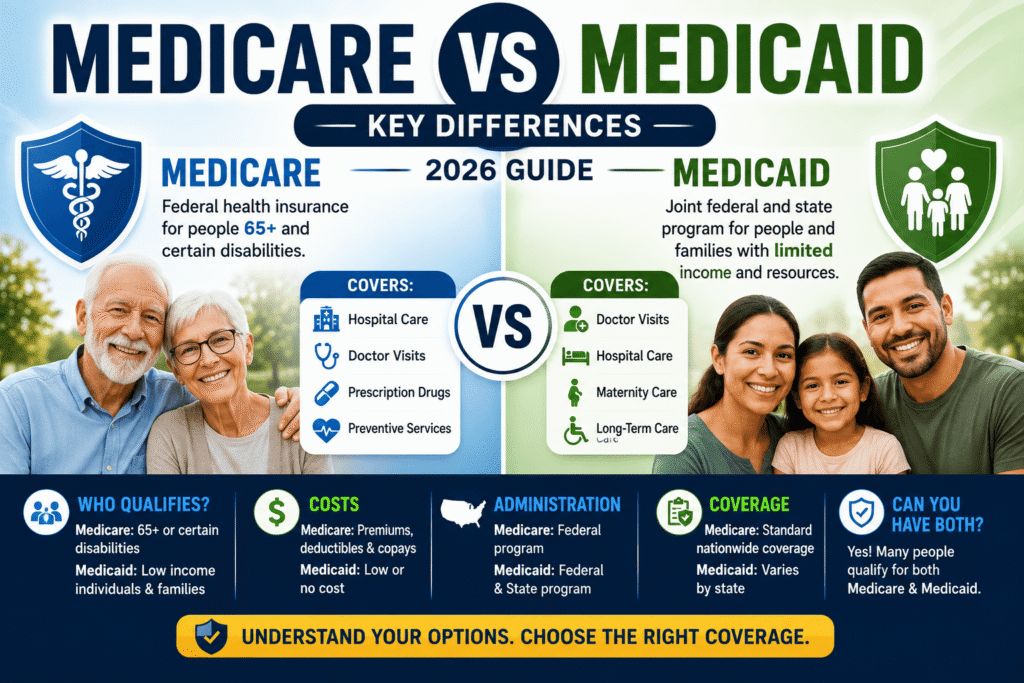
Medicare vs Medicaid: Key Differences
Navigating the U.S. healthcare system can be confusing, especially when comparing Medicare vs Medicaid. Although both programs help millions of Americans access affordable healthcare, they serve different groups of people and have different eligibility requirements, benefits, and costs.
Many people mistakenly think Medicare and Medicaid are the same because both are government-sponsored health insurance programs. However, Medicare is primarily designed for older adults and certain people with disabilities, while Medicaid helps individuals and families with limited income and resources.
Understanding the differences between these two programs can help you choose the right healthcare coverage for yourself or your loved ones. In this guide, we’ll explain how Medicare and Medicaid work, who qualifies, what each program covers, and how to determine which option best fits your needs.
What Is Medicare?
Medicare is a federal health insurance program primarily designed for people aged 65 and older. It also provides coverage for certain younger individuals with qualifying disabilities or specific medical conditions, such as End-Stage Renal Disease (ESRD) or Amyotrophic Lateral Sclerosis (ALS).
Unlike private health insurance, Medicare is administered by the federal government and offers standardized coverage across the country.
Medicare consists of several parts:
Medicare Part A
Helps cover:
- Hospital stays
- Skilled nursing facilities
- Hospice care
- Limited home healthcare
Medicare Part B
Helps pay for:
- Doctor visits
- Preventive services
- Outpatient care
- Medical equipment
- Lab tests
Medicare Part C (Medicare Advantage)
Private insurance plans approved by Medicare that combine Part A and Part B, often including additional benefits such as vision, dental, hearing, and prescription drug coverage.
Medicare Part D
Provides prescription drug coverage through approved private insurance companies.
What Is Medicaid?
Medicaid is a joint federal and state healthcare program that provides medical coverage for eligible individuals and families with limited income.
Because states administer Medicaid, eligibility rules, covered services, and income limits vary depending on where you live.
Medicaid helps millions of Americans receive affordable healthcare, including:
- Children
- Pregnant women
- Seniors with limited income
- People with disabilities
- Low-income adults
- Certain caregivers
Medicare vs Medicaid: Key Differences
| Feature | Medicare | Medicaid |
|---|---|---|
| Program Type | Federal | Federal & State |
| Primary Purpose | Seniors & certain disabilities | Low-income individuals & families |
| Age Requirement | Usually 65+ | No age requirement |
| Income Requirement | Generally not income-based | Income-based |
| Coverage | Standard nationwide | Varies by state |
| Premiums | May apply | Usually low or no premium |
| Prescription Drugs | Part D | Usually included |
| Long-Term Care | Limited | Often covered |
Who Qualifies for Medicare?
You may qualify for Medicare if you:
- Are 65 years or older
- Have received Social Security Disability benefits for at least 24 months
- Have ESRD requiring dialysis or kidney transplant
- Have ALS (Lou Gehrig’s disease)
Many people automatically enroll in Medicare when they begin receiving Social Security benefits.
Who Qualifies for Medicaid?
Medicaid eligibility depends largely on household income and other state-specific requirements.
You may qualify if you are:
- A low-income adult
- A child
- Pregnant
- A senior with limited income
- Living with a disability
- Receiving Supplemental Security Income (SSI) in many states
Because each state manages its own Medicaid program, eligibility rules can differ significantly.
What Does Medicare Cover?
Medicare provides coverage for many essential healthcare services.
Covered services typically include:
- Hospital care
- Doctor appointments
- Preventive screenings
- Laboratory testing
- Medical equipment
- Home healthcare (limited)
- Prescription medications (Part D)
Some services, such as dental care, vision care, and hearing aids, may require a Medicare Advantage plan or separate coverage.
What Does Medicaid Cover?
Medicaid often provides broader healthcare benefits than Medicare.
Coverage commonly includes:
- Doctor visits
- Hospital care
- Emergency services
- Prescription drugs
- Mental health services
- Maternity care
- Pediatric care
- Long-term nursing home care
- Home health services
Many Medicaid programs also provide transportation assistance for medical appointments.
Medicare vs Medicaid Costs
One of the biggest differences between Medicare and Medicaid is cost.
Medicare Costs
Depending on your coverage, you may pay:
- Monthly premiums
- Deductibles
- Copayments
- Coinsurance
Some Medicare beneficiaries also purchase Medicare Supplement (Medigap) policies to help reduce out-of-pocket costs.
Medicaid Costs
Most Medicaid recipients pay little or nothing for covered healthcare services.
Many states charge:
- No monthly premium
- Minimal copayments
- Low or no deductibles
Can You Have Both Medicare and Medicaid?
Yes.
Some individuals qualify for both Medicare and Medicaid. These beneficiaries are often referred to as “dual eligible.”
If you qualify for both programs:
- Medicare generally pays first.
- Medicaid may help cover remaining costs, including premiums, deductibles, and copayments.
- You may receive additional benefits not covered by Medicare alone.
Dual eligibility can significantly reduce healthcare expenses.
Which Program Is Right for You?
The right program depends on your age, income, health condition, and financial situation.
Medicare May Be Right If You:
- Are age 65 or older
- Have qualifying disabilities
- Need nationwide health coverage
- Want Medicare Advantage options
Medicaid May Be Right If You:
- Meet your state’s income requirements
- Need comprehensive healthcare
- Require long-term care services
- Have limited financial resources
If you’re eligible for both programs, combining Medicare and Medicaid can provide the broadest coverage while minimizing out-of-pocket costs.
Common Mistakes to Avoid
When comparing Medicare vs Medicaid, many people make avoidable mistakes, including:
- Assuming both programs are the same
- Missing enrollment deadlines
- Choosing coverage based only on cost
- Ignoring Medicare Advantage options
- Not checking state Medicaid eligibility
- Forgetting to review coverage annually
Taking the time to understand your options can help you avoid unexpected healthcare expenses.
Frequently Asked Questions
Is Medicare the same as Medicaid?
No. Medicare primarily serves seniors and certain people with disabilities, while Medicaid provides healthcare coverage for eligible low-income individuals and families.
Who pays for Medicare?
Medicare is funded through federal taxes, payroll taxes, premiums, and general government revenue.
Is Medicaid free?
Many Medicaid recipients pay little or no monthly premium, although costs vary by state and individual circumstances.
Can seniors qualify for Medicaid?
Yes. Seniors with limited income and resources may qualify for Medicaid, particularly if they require long-term care or assistance with Medicare costs.
Which program covers nursing home care?
Medicaid generally provides broader coverage for long-term nursing home care than Medicare.
Conclusion
Understanding the differences between Medicare vs Medicaid is essential for making informed healthcare decisions. While Medicare primarily serves seniors and people with certain disabilities, Medicaid helps eligible individuals and families with limited income access affordable healthcare.
Each program offers valuable benefits, but eligibility, costs, and coverage differ significantly. Before enrolling, compare your options carefully, review your healthcare needs, and determine whether you qualify for one—or even both—programs.
If you’re unsure which option is right for you, compare available health insurance plans or request a personalized insurance quote to find coverage that meets your medical needs and budget.
Centers for Medicare & Medicaid Services (CMS): https://www.cms.gov Medicare Official Website: https://www.medicare.gov Medicaid Official Information: https://www.medicaid.gov