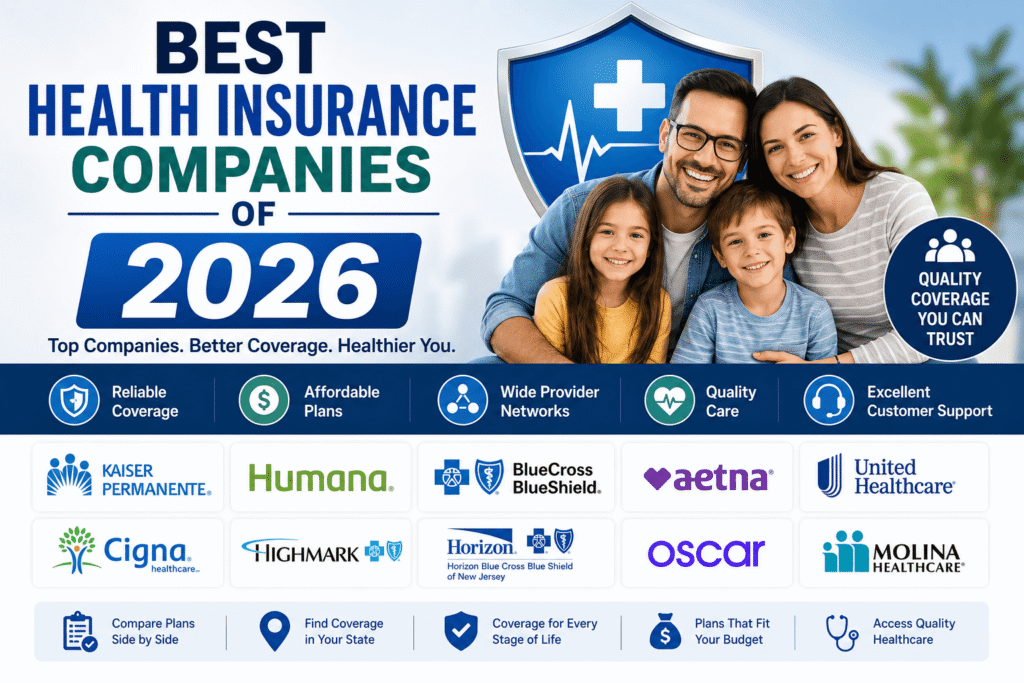
Best Health Insurance Companies of 2026
Choosing health insurance can be confusing. There are different companies, plan types, provider networks, deductibles, copays, coinsurance, and out-of-pocket limits to compare.
And the “best” health insurance company isn’t necessarily the one with the lowest premium.
For 2026, Kaiser Permanente ranks first in Insure.com’s national health insurance comparison, followed by Humana and Horizon Blue Cross Blue Shield of New Jersey. The ranking considers customer feedback, affordability, plan offerings, provider availability, NCQA ratings, and complaint data.
Other 2026 research gives different insurers strong marks for specific needs. ValuePenguin, for example, highlights Kaiser Permanente, Blue Cross Blue Shield, UnitedHealthcare, and Oscar for different types of health insurance shoppers.
That difference is important. Your state, doctors, prescriptions, budget, and preferred type of plan can make one insurer a much better fit than another.
Best Health Insurance Companies in 2026
Here are some of the health insurance companies worth comparing this year:
| Health Insurance Company | Best For |
|---|---|
| Kaiser Permanente | Best overall |
| Humana | Affordability and Medicare coverage |
| Blue Cross Blue Shield | Provider network and plan variety |
| Aetna | Affordable plans and broad options |
| UnitedHealthcare | Large provider network |
| Cigna Healthcare | Digital experience |
| Highmark | Regional coverage and provider network |
| Horizon BCBS of New Jersey | Customer satisfaction |
| Oscar Health | Digital-first individual coverage |
| Molina Healthcare | Medicaid and value-focused coverage |
1. Kaiser Permanente – Best Overall
Kaiser Permanente stands out as one of the strongest health insurance choices in 2026.
Insure.com ranked Kaiser Permanente No. 1 nationally with a score of 4.42 out of 5. The company has held the top position in that ranking for six consecutive years.
Kaiser uses an integrated model that combines health insurance with its own network of doctors, hospitals, and medical facilities in the areas it serves.
That can make the healthcare experience more coordinated because many services are managed within the same system.
Kaiser also performed well in NCQA’s health plan ratings, which evaluate measures related to quality of care and member experience.
Best for: People who live in a Kaiser service area and prefer an integrated healthcare system.
Potential drawback: Kaiser isn’t available in every state, and its network model may be less attractive if you want maximum flexibility to see providers outside the system.
2. Humana – Best for Medicare and Affordability
Humana ranks highly in 2026 health insurance comparisons, placing second in Insure.com’s national ranking with a score of 4.23.
The company is particularly well known for Medicare-related coverage.
Insure.com’s 2026 analysis also ranked Humana highly for affordability, customer service, and low deductibles.
If you’re shopping for Medicare Advantage or other senior-focused coverage, Humana can be worth including in your comparison.
However, Medicare plan availability and benefits can vary significantly by county.
Best for: Medicare shoppers and people looking for competitive plan costs.
Potential drawback: Benefits and plan availability can vary substantially by location.
3. Blue Cross Blue Shield – Best for Provider Network
Blue Cross Blue Shield isn’t one single national insurance company. It is a collection of independent companies operating under the Blue Cross Blue Shield brand.
That means the experience can be very different depending on the Blue plan available in your state.
Blue Cross Blue Shield companies are often attractive to people who want broad provider access and different plan types. MoneyGeek’s 2026 analysis ranked BCBS as its best overall provider for HMO, PPO, and POS plans.
Best for: People who prioritize provider choice and plan variety.
Potential drawback: Coverage, pricing, and customer service depend heavily on the local BCBS company.
4. Aetna – Best for Broad Plan Options
Aetna, part of CVS Health, is another major health insurance provider worth comparing in 2026.
Insure.com ranked Aetna seventh in its 2026 national comparison with a score of 4.07.
Aetna offers a variety of health coverage options, and its connection with CVS Health can be useful for customers who value an integrated healthcare and pharmacy ecosystem.
Best for: Individuals and families looking for a large insurer with multiple plan options.
Potential drawback: Provider networks and plan availability differ by state.
5. UnitedHealthcare – Best for Large Networks
UnitedHealthcare is one of the largest health insurance companies in the United States.
Its size can be an advantage for people who want access to a large network of doctors, hospitals, and healthcare providers.
ValuePenguin selected UnitedHealthcare as its 2026 pick for self-employed health insurance.
UnitedHealthcare also ranked third among commercial plans in J.D. Power’s 2026 healthcare digital experience results, behind Cigna and Premera Blue Cross.
Best for: People who value a large provider network and broad availability.
Potential drawback: The largest network isn’t necessarily the best value if your preferred doctors aren’t included in your specific plan.
6. Cigna Healthcare – Best Digital Experience
Cigna Healthcare is another major insurer with a strong digital presence.
J.D. Power’s 2026 U.S. Healthcare Digital Experience Study ranked Cigna highest among commercial health plans, with a score of 684 out of 1,000.
The study evaluated areas such as website and app navigation, information quality, speed, visual appeal, and telehealth.
For people who prefer managing insurance, appointments, information, and healthcare services online, a strong digital experience can make a noticeable difference.
Best for: People who value digital tools and online healthcare management.
Potential drawback: Digital experience is only one part of choosing a health insurance plan.
7. Highmark – Best Regional Option
Highmark is a major regional health insurer and performed particularly well in the 2026 rankings.
Insure.com placed Highmark fifth nationally with a score of 4.13. It also identified Highmark as one of the companies tied for the strongest provider-network category in its research.
If Highmark operates in your state, it is worth comparing its plans against other available insurers.
Best for: Customers in Highmark’s service areas who want strong regional coverage.
Potential drawback: Availability is limited geographically.
8. Horizon Blue Cross Blue Shield of New Jersey – Best for Customer Satisfaction
Horizon BCBS of New Jersey ranked third in Insure.com’s 2026 national comparison, with a score of 4.16.
It also received the highest ranking in several customer-focused categories in the 2026 research, including policy offerings and likelihood to be recommended.
For New Jersey residents, Horizon is worth including when comparing available health plans.
Best for: New Jersey residents who prioritize customer experience and plan choices.
Potential drawback: Its availability is primarily regional.
9. Oscar Health – Best for Digital-First Individual Coverage
Oscar Health has positioned itself as a technology-focused health insurer.
Its digital-first approach can appeal to people who prefer managing their health insurance online and using virtual healthcare services.
ValuePenguin included Oscar among its four best health insurance companies for 2026 and selected it for helping members get the care they need.
Oscar is particularly worth researching if you’re buying individual or family Marketplace coverage.
Best for: People who prefer a digital-first health insurance experience.
Potential drawback: Availability and network options vary by state.
10. Molina Healthcare – Best for Value-Focused Coverage
Molina Healthcare is a major insurer focused heavily on government-sponsored health programs, including Medicaid and Medicare.
It may be particularly relevant for shoppers whose eligibility makes them eligible for these programs.
Molina appears among the insurers evaluated in 2026 national health insurance comparisons, although its overall ranking is below several of the companies listed above.
Best for: Eligible Medicaid and Medicare members looking for value-focused coverage.
Potential drawback: The plans and provider networks available depend heavily on your state and eligibility.
What Makes a Health Insurance Company Good in 2026?
Choosing a health insurer shouldn’t be based on the company’s name alone.
There are several things you should check before choosing a plan.
Provider Network
A health insurance plan is only useful if you can access the doctors and hospitals you want.
Before enrolling, check whether your:
- Primary care doctor
- Specialists
- Preferred hospital
- Urgent care center
- Pharmacy
are included in the plan’s network.
This can be more important than choosing a nationally recognized insurance company.
Premium
The premium is the amount you pay for your insurance coverage, usually every month.
A lower premium can be attractive, but don’t stop your comparison there.
A plan with a $300 monthly premium could ultimately cost more than a $400 plan if it has much higher deductibles and out-of-pocket costs.
Deductible
The deductible is the amount you generally pay for covered services before the plan begins paying according to its benefits.
A lower deductible often means a higher premium.
Copay and Coinsurance
A copay is usually a fixed amount you pay for a covered service.
Coinsurance is generally a percentage of the allowed cost you pay after meeting the deductible.
Both can significantly affect your actual healthcare costs.
Out-of-Pocket Maximum
This is one of the most important numbers to check.
The out-of-pocket maximum limits how much you pay for covered in-network services during a plan year, subject to the plan’s terms.
If you have frequent medical expenses, a plan with a higher premium but lower out-of-pocket exposure may make more financial sense.
How Much Does Health Insurance Cost in 2026?
There isn’t one price for health insurance.
Your premium can depend on:
- Age
- Location
- Household size
- Income
- Plan type
- Coverage level
- Tobacco use where applicable
- Employer contributions
- Eligibility for subsidies or tax credits
HealthCare.gov provides 2026 plan and price information so consumers can preview available plans based on their location and circumstances.
Marketplace prices can also be significantly lower for people who qualify for financial assistance.
That’s why comparing your actual available plans is more useful than relying on a national average.
How to Choose the Best Health Insurance Plan
The best health insurance company and the best health insurance plan are not always the same thing.
A highly rated insurer can offer a plan that isn’t suitable for you.
Start With Your Doctors
Before comparing premiums, check your preferred doctors and hospitals.
If your doctor isn’t in-network, you may have to pay substantially more depending on the plan.
Check Your Prescription Drugs
If you take regular medication, check the plan’s formulary.
Two plans from the same company can have different drug coverage and cost-sharing.
Compare Total Costs
Don’t compare only monthly premiums.
Look at:
- Annual premium
- Deductible
- Copays
- Coinsurance
- Out-of-pocket maximum
- Prescription costs
- Provider network
- Specialist costs
This gives you a much better picture of what the plan could actually cost.
Check Referral Requirements
Some plans require referrals before you can see certain specialists.
If you prefer direct access to specialists, compare plan structures carefully.
Consider Your Healthcare Usage
Someone who rarely visits a doctor may prioritize a lower monthly premium.
Someone who has regular appointments or expensive prescriptions may benefit from a plan with a higher premium but lower out-of-pocket costs.
HMO vs. PPO vs. EPO
The type of health plan matters just as much as the insurance company.
HMO
Health Maintenance Organization plans typically emphasize an in-network provider system.
They can offer lower costs but may provide less flexibility outside the network.
PPO
Preferred Provider Organization plans generally provide more flexibility to see providers outside the network, although out-of-network care usually costs more.
PPO plans can be attractive if provider choice is important to you.
EPO
Exclusive Provider Organization plans generally require you to use the plan’s network except for emergencies.
They can provide a balance between cost and network structure.
POS
Point-of-Service plans combine features of HMO and PPO plans.
The exact rules depend on the insurer and policy.
How to Save Money on Health Insurance
You don’t necessarily need to choose the cheapest plan to reduce your overall healthcare costs.
Compare Multiple Plans
Don’t automatically renew the same plan every year.
Compare the options available to you and look at total potential costs.
Check for Marketplace Savings
If you’re buying individual coverage, check whether you qualify for premium tax credits or other savings.
HealthCare.gov allows consumers to preview 2026 plans and estimated prices before applying.
Use In-Network Providers
Using doctors, hospitals, and pharmacies within your plan’s network can help keep your healthcare costs under control.
Compare Prescription Costs
A plan with a slightly higher premium could still be cheaper overall if it provides better coverage for the medications you regularly use.
Consider an HSA-Eligible Plan
If you’re eligible for a Health Savings Account, a high-deductible health plan may be worth considering.
Compare the deductible, out-of-pocket maximum, premium, and potential HSA tax advantages before making a decision.
Best Health Insurance Companies for Different Needs
Different shoppers may want different things from their insurer.
Best Overall
Kaiser Permanente is the highest-ranked company in Insure.com’s 2026 national comparison.
Best for Provider Choice
Blue Cross Blue Shield is a strong choice if you want different plan types and broad provider options, although availability depends on your local Blue plan.
Best for Medicare
Humana is worth considering for Medicare-focused coverage and ranked second overall in Insure.com’s 2026 health insurance comparison.
Best for Digital Experience
Cigna Healthcare ranked highest among commercial plans in J.D. Power’s 2026 healthcare digital experience study.
Best for Self-Employed People
UnitedHealthcare was selected by ValuePenguin as its 2026 choice for self-employed health insurance.
Best for Digital-First Individual Coverage
Oscar Health is worth considering if you prefer a technology-focused health insurance experience.
Frequently Asked Questions
What is the best health insurance company in 2026?
Kaiser Permanente ranks No. 1 in Insure.com’s 2026 national comparison, followed by Humana and Horizon Blue Cross Blue Shield of New Jersey. However, the best insurer for you depends on your state, doctors, prescriptions, budget, and plan needs.
Is Kaiser Permanente the best health insurance company?
Kaiser Permanente is one of the strongest choices in 2026 and ranks first in Insure.com’s national comparison. However, it isn’t available everywhere, and its integrated network model may not suit everyone.
Which health insurance has the best provider network?
Blue Cross Blue Shield is often attractive for provider choice, but network size and access depend on the specific Blue plan in your state. Always verify your doctors and hospitals before enrolling.
Is UnitedHealthcare a good health insurance company?
UnitedHealthcare is one of the largest U.S. health insurers and can be a strong option for people who value broad provider access. Its 2026 ranking and performance vary depending on the type of plan being evaluated.
How do I find the cheapest health insurance?
Compare plans based on both premiums and expected healthcare costs. Check whether you qualify for financial assistance through the Marketplace, and compare deductibles, copays, coinsurance, networks, and out-of-pocket maximums.
What is the difference between health insurance companies and health plans?
An insurance company may offer many different plans. Each plan can have its own provider network, premium, deductible, copays, prescription coverage, and out-of-pocket maximum.
Should I choose health insurance based on company rankings?
Rankings are a useful starting point, but they shouldn’t be your only consideration. A highly rated insurer may not have your preferred doctor or the right plan in your state.
Final Thoughts
The best health insurance company in 2026 depends on what matters most to you.
Kaiser Permanente stands out in national rankings, while Humana is particularly relevant for Medicare shoppers. Blue Cross Blue Shield can be attractive for provider choice, UnitedHealthcare for broad networks, and Cigna Healthcare for digital service.
Regional insurers such as Horizon BCBS of New Jersey and Highmark can also be excellent choices where they’re available.
Before choosing a policy, compare the premium, deductible, provider network, prescription coverage, copays, coinsurance, and out-of-pocket maximum.
And remember that the best insurance company isn’t necessarily the company with the highest ranking. It’s the company offering a plan that works well for your doctors, your healthcare needs, your budget, and your location.
- NCQA Health Plan Ratings 2026
- HealthCare.gov — 2026 Plans & Prices
- CMS — 2026 Medicare Advantage & Part D Star Ratings
- HealthCare.gov Health Plan Research Data
PolicyAIHub Tip: Don’t compare health insurance plans by monthly premium alone. Check your doctors, prescriptions, deductible, out-of-pocket maximum, and total potential healthcare costs before choosing a plan.