
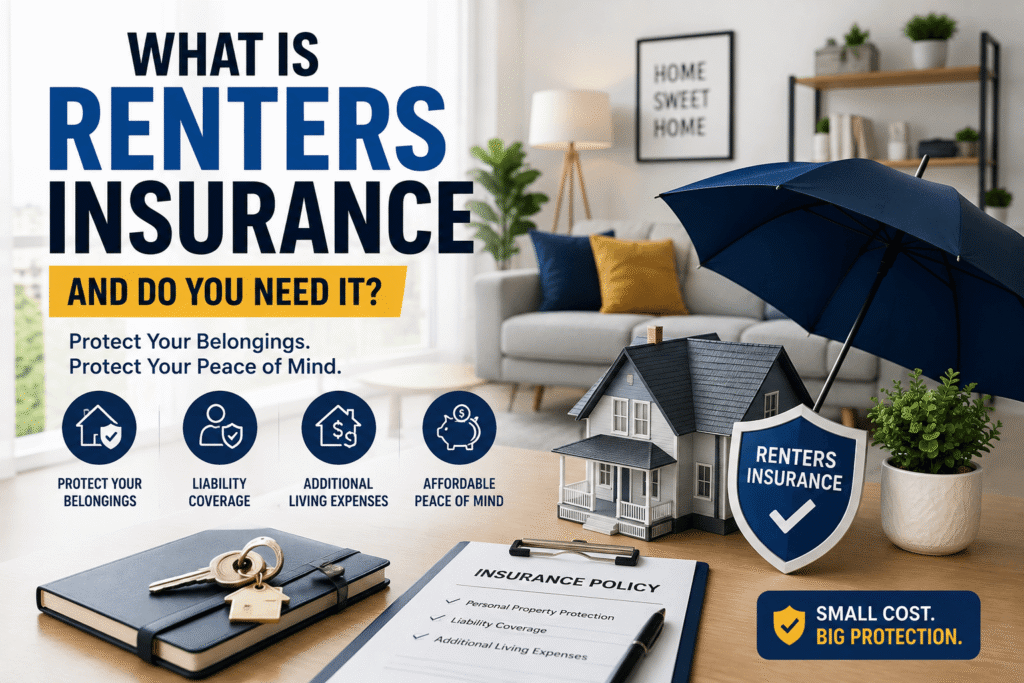
What Is Renters Insurance?
If you rent an apartment, house, or condo, you might assume your landlord’s insurance protects everything inside your home.
It usually doesn’t.
A landlord’s insurance policy generally protects the building itself, while renters insurance can help protect your personal belongings and your financial interests as a tenant.
Renters insurance is designed for people who rent their living space rather than own it. Depending on the policy, it can help cover personal property after certain covered events, provide liability protection, and potentially help with additional living expenses if a covered loss makes your home temporarily unlivable.
For many renters, it can be a relatively inexpensive way to add financial protection against unexpected events.
But is renters insurance actually worth it?
For most renters, it’s worth seriously considering.
What Does Renters Insurance Cover?
Renters insurance coverage varies by insurance company and policy, but a typical policy may include several important types of protection.
1. Personal Property Coverage
This is one of the main reasons people purchase renters insurance.
Personal property coverage may help pay to repair or replace belongings damaged or stolen as a result of a covered event.
Your belongings could include:
- Furniture
- Clothing
- Television
- Laptop
- Smartphone
- Kitchen appliances
- Electronics
- Jewelry
- Sports equipment
- Books
- Personal items
For example, imagine a pipe bursts in your apartment and water damages your furniture, laptop, and clothing.
If the loss is covered by your policy, renters insurance may help pay for the covered belongings, subject to your deductible, limits, and policy terms.
The important point is that not every type of damage is automatically covered.
2. Liability Coverage
Renters insurance can also provide personal liability protection.
This can become important if you accidentally cause injury to another person or damage someone else’s property and you are legally responsible.
For example, suppose a visitor slips inside your apartment and suffers an injury.
Depending on the circumstances and your policy, liability coverage may help with covered expenses and legal costs, subject to policy limits and conditions.
Liability coverage can also apply to certain accidental property damage caused by you.
3. Additional Living Expenses
What happens if your rented home becomes temporarily unlivable because of a covered event?
Some renters insurance policies provide additional living expenses (ALE) or similar coverage.
Depending on the policy, this could help with certain additional costs such as:
- Temporary accommodation
- Increased food expenses
- Transportation costs
- Other necessary expenses
For example, if a covered fire makes your apartment temporarily uninhabitable, your policy may help with eligible additional living expenses while repairs are completed.
The exact coverage, limits, and eligibility depend on the policy.
What Does Renters Insurance Usually Not Cover?
This is where many renters get confused.
Renters insurance isn’t a blanket protection plan for everything that could possibly happen.
Common exclusions or limitations may include certain events such as:
- Flood damage
- Earthquake damage
- Normal wear and tear
- Pest infestations
- Maintenance-related problems
- Intentional damage
Some risks may require separate insurance or an endorsement.
For example, standard renters insurance generally doesn’t provide flood insurance coverage for flood damage. If you live in an area where flooding is a concern, you may want to investigate separate flood coverage.
Always read your policy carefully because exclusions and coverage vary between insurers.
Does Renters Insurance Cover Theft?
It can.
Personal property coverage may cover theft when the theft results from a covered circumstance, subject to the policy’s terms and limits.
For example, imagine someone breaks into your apartment and steals:
- Laptop
- Television
- Camera
- Jewelry
- Clothing
You may be able to file a renters insurance claim for covered stolen property.
You will typically need to provide information about the loss, and a police report may be useful or required depending on the circumstances and insurer.
A helpful tip
Create a home inventory.
Take photographs or videos of your valuable belongings and keep receipts or other proof of ownership when available.
Store the inventory somewhere safe, preferably outside your home or in secure cloud storage.
If you ever need to file a claim, you’ll be glad you have it.
Does My Landlord’s Insurance Cover My Belongings?
Generally, no.
Your landlord typically has insurance for the building and their own property.
That coverage generally doesn’t replace your personal belongings.
Imagine your apartment building experiences a major fire.
The landlord’s insurance may cover repairs to the building, but your:
- Clothes
- Laptop
- Furniture
- Television
- Personal belongings
are generally your responsibility.
That’s one of the main reasons renters consider purchasing their own insurance.
Do You Really Need Renters Insurance?
There is no universal answer because everyone’s financial situation and lease requirements are different.
However, renters insurance can make sense if replacing your belongings or dealing with a liability claim would create a significant financial burden.
Consider this question:
Could you afford to replace everything you own tomorrow?
Think about your:
- Bed
- Sofa
- TV
- Computer
- Phone
- Clothes
- Kitchen equipment
- Children’s belongings
- Jewelry
- Electronics
The total replacement cost can be much higher than people expect.
Renters insurance can provide a financial safety net for covered losses.
Is Renters Insurance Required?
In some situations, yes.
A state may not require renters insurance generally, but your landlord or lease may require you to maintain a policy.
Many apartment communities include an insurance requirement in their lease agreement.
If your lease requires renters insurance, check:
- Minimum liability coverage
- Required policy limits
- Whether the landlord must be listed as an interested party
- Proof-of-insurance requirements
- Renewal requirements
If you’re unsure, read your lease or ask your property manager.
How Much Does Renters Insurance Cost?
Renters insurance is often relatively affordable compared with many other types of insurance, but the price varies.
Your premium can depend on factors such as:
- Location
- Coverage amount
- Deductible
- Claims history
- Building characteristics
- Selected coverage
- Liability limits
- Optional endorsements
Someone renting an apartment in a low-risk area may pay a different premium from someone renting a house in an area with higher risks.
Instead of choosing a policy based only on price, compare the coverage and limits.
A cheaper policy isn’t necessarily the better deal if it doesn’t provide the protection you need.
What Is a Renters Insurance Deductible?
A deductible is the amount you generally pay toward a covered claim before the insurance company pays the remaining eligible amount.
For example, suppose:
Covered loss: $5,000
Deductible: $500
If the claim is covered and subject to that deductible, the insurer could pay $4,500, assuming there are no other applicable limits or adjustments.
Some policies offer different deductible options.
A higher deductible can sometimes reduce your premium, while a lower deductible may increase the premium.
Choose an amount you could realistically afford if you needed to file a claim.
Actual Cash Value vs. Replacement Cost
When comparing renters insurance policies, pay attention to how personal property claims are valued.
Actual Cash Value
Actual cash value generally considers depreciation when determining the value of covered property.
For example, an older television may be worth considerably less today than what you originally paid for it.
Replacement Cost
Replacement cost coverage generally aims to cover the cost of replacing covered property with a similar item, subject to the policy’s terms and limits.
Because these approaches can produce different claim payments, it’s important to understand which type of coverage your policy provides.
How Much Renters Insurance Coverage Do You Need?
There’s no single amount that works for everyone.
Start by estimating the replacement cost of everything you own.
Walk through your home room by room.
Bedroom
- Clothing
- Furniture
- Electronics
- Jewelry
Living Room
- Television
- Sofa
- Entertainment equipment
- Furniture
Kitchen
- Appliances
- Cookware
- Small appliances
Office
- Computer
- Monitor
- Printer
- Desk
- Accessories
Add everything together.
You may be surprised by the total.
Also check whether certain high-value items have special limits.
Jewelry, collectibles, firearms, electronics, and other valuables may have specific coverage limitations under some policies.
You may need additional coverage for certain valuable items.
How to Choose a Renters Insurance Policy
Don’t compare policies based only on the monthly premium.
Look at:
Personal Property Coverage
How much coverage is provided for your belongings?
Liability Coverage
How much personal liability protection is included?
Deductible
How much would you pay out of pocket for a covered claim?
Additional Living Expenses
Does the policy provide coverage if your home becomes unlivable after a covered event?
Replacement Cost vs. Actual Cash Value
Understand how your belongings would be valued after a covered loss.
Exclusions
Read what the policy doesn’t cover.
Coverage Limits
Check whether specific categories of belongings have lower limits.
Renters Insurance for Apartment Dwellers
If you rent an apartment, renters insurance can be especially useful.
Apartment buildings can expose residents to risks that aren’t entirely within their control.
For example:
- A neighboring apartment has a fire.
- A water leak damages your belongings.
- Someone steals your property.
- A visitor gets injured in your apartment.
You may not be responsible for the building itself, but your personal property and liability exposure are still important considerations.
Renters Insurance for College Students
College students may have different insurance needs.
Depending on the student’s living arrangement and family policy, belongings may sometimes receive coverage under a parent’s homeowners or renters insurance policy.
However, coverage can vary significantly depending on the policy and circumstances.
Students living off-campus may need their own renters insurance policy.
Before purchasing anything, parents and students should check the existing policy to understand what is already covered.
What About Roommates?
If you share an apartment with roommates, don’t automatically assume everyone is covered by one policy.
Some insurers may allow certain arrangements, while others may require separate policies.
Before sharing a renters insurance policy, ask the insurer:
- Who is covered?
- Whose belongings are covered?
- What are the coverage limits?
- Does liability coverage apply to everyone?
- Are there restrictions for unrelated roommates?
A separate policy may be the simplest option for each roommate.
How to Save Money on Renters Insurance
There are several ways to potentially reduce your premium.
Compare Multiple Insurers
Prices can vary significantly between companies.
Ask About Discounts
Insurers may offer discounts for things such as:
- Security systems
- Smoke alarms
- Bundling policies
- Claims-free history
- Automatic payments
Discount availability varies by insurer.
Choose Your Deductible Carefully
A higher deductible may lower your premium, but make sure you can afford the deductible if you need to file a claim.
Don’t Underinsure Your Belongings
Saving money by choosing too little coverage could leave you financially exposed after a major loss.
How to File a Renters Insurance Claim
If something happens and you believe you have a covered loss, start by making sure everyone is safe.
Then:
- Document the damage with photographs or video.
- Prevent additional damage when reasonably possible and safe.
- Report the incident to the appropriate authorities when necessary.
- Contact your insurance company promptly.
- Keep receipts for eligible expenses.
- Provide the requested documentation.
- Keep copies of everything you submit.
- Record communications with your insurer.
- Review the settlement carefully.
Your policy may have specific requirements, so follow the instructions provided by your insurer.
Renters Insurance Checklist
Before buying a policy, ask yourself:
☐ How much would it cost to replace everything I own?
☐ What is my deductible?
☐ Does the policy use replacement cost or actual cash value?
☐ How much liability coverage do I have?
☐ Are my expensive belongings adequately covered?
☐ Are there important exclusions?
☐ Does my lease require renters insurance?
☐ Does the policy include additional living expenses?
☐ Do I need additional coverage for valuables?
☐ Have I compared multiple quotes?
Frequently Asked Questions
Is renters insurance worth it?
For many renters, yes. It can provide protection for personal belongings and liability against certain covered losses, potentially at a relatively affordable cost.
Does renters insurance cover my landlord’s property?
Generally, your renters policy is designed to cover your belongings and certain liabilities rather than the landlord’s building. The landlord typically has separate insurance for the property.
Does renters insurance cover water damage?
It depends on the source of the water and your policy. Some types of water damage may be covered, while flooding is generally excluded from standard renters policies and may require separate coverage.
Does renters insurance cover theft?
Many renters policies provide personal property coverage for theft under covered circumstances, subject to policy terms, deductibles, and limits.
Can my landlord require renters insurance?
A landlord may require renters insurance as a condition of the lease. Check your rental agreement for the specific requirements.
How much renters insurance should I buy?
Choose enough personal property coverage to reasonably replace your belongings, and pay attention to special limits for high-value items.
Is renters insurance expensive?
The cost varies by location, coverage, deductible, insurer, and other factors. Comparing quotes can help you find an option that fits your budget.
Final Thoughts
Renting a home doesn’t mean you have to leave your belongings and financial protection to chance.
Renters insurance can help protect your personal property, provide liability coverage, and potentially help with additional living expenses after certain covered losses.
The right policy depends on where you live, what you own, your financial situation, and the risks you’re most concerned about.
Before buying a policy, don’t just ask “How much does it cost?”
Ask:
“What would this policy actually protect me from?”
Compare coverage, deductibles, limits, exclusions, and policy terms—not just the monthly price.
A few minutes spent understanding your coverage today could save you a lot of stress if something unexpected happens tomorrow.
Important Disclaimer
This article is provided for general educational and informational purposes only and does not constitute insurance, financial, or legal advice. Insurance coverage, exclusions, limits, costs, and requirements vary by insurer, policy, and state. Review your policy documents and speak with a licensed insurance professional for advice about your specific situation.